
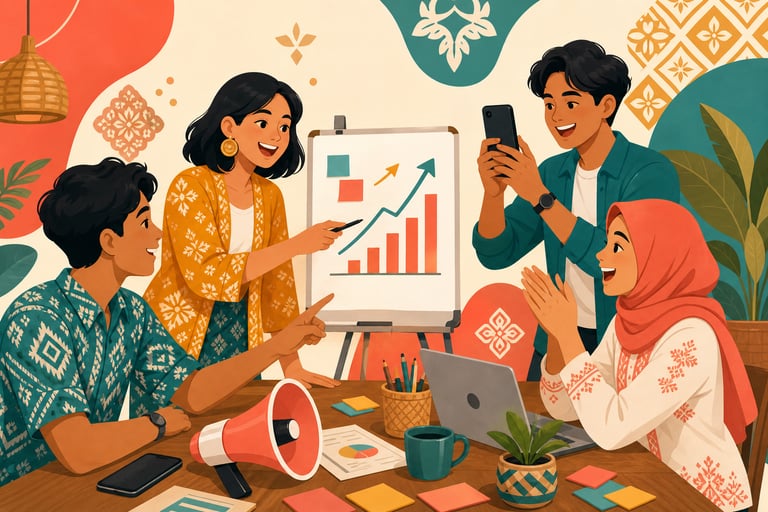
Marketing Workshops Playbook
A hands-on guide for facilitators teaching Indonesian youth to promote the ideas they care about — built for hybrid delivery.
About This Playbook
This playbook is a complete, ready-to-run series of eight workshops that teach young Indonesians how to market their ideas and projects. It is written for facilitators — youth community leaders, teachers, campus organisation members, NGO staff, or anyone who wants to run a workshop without being a marketing expert themselves. You do not need a marketing degree to use it; every session comes with a script, timing, activities, and a take-home task.
The workshops treat marketing not as hype or "selling out," but as a practical life skill: how to tell people what you are making, why it matters, and why they should care — honestly and effectively. Each session is designed to be interactive from the first minute, because young people learn by doing, not by listening to lectures.
Hybrid by design. Every workshop is written so it can run fully in person, fully online, or in a mixed mode where some participants join from home. A consistent section called Go Hybrid explains exactly what to change for each format.
Who this is for
Participants: Indonesian youth aged roughly 15–25 — students, early-career creators, community organisers, first-time founders, and anyone with an idea they want seen.
Facilitators: people who will actually run the sessions. No prior marketing experience assumed.
The series in one breath
Participants start by clarifying what their idea is and who it serves, learn to craft messages people actually remember, produce content for the platforms they already use, build a community around the project, read simple numbers, launch on a real budget, and finish with a showcase where they present what they built.
Three ground rules
Marketing is storytelling, not shouting. People remember stories, not slogans.
Start with the audience, not yourself. Know who you are talking to before you talk.
Learn by testing. Post it, watch what happens, improve. Perfection is the enemy of momentum.
These ground rules repeat across every workshop, because they are the heart of the whole series.
Understanding Indonesian Youth
Before teaching young people to market, understand the context they live in. This is not a lecture module — it is background that should shape how you run every session.
Mobile-first & social-native
For most Indonesian youth, the smartphone is the primary — often the only — window to the internet. Content is consumed vertically, in short bursts, on the platforms they already spend their day in. If a workshop activity feels like it needs a laptop, simplify it to work on a phone.
The platforms that matter
TikTok, Instagram (Reels and Stories), YouTube (including Shorts), and X/Twitter are where ideas travel fastest among youth. WhatsApp is the quiet giant — much real community building, group coordination, and even commerce happens in WhatsApp groups, and it is often free of data cost through cheap plans and Wi-Fi hotspots.
Community before audience
Indonesian culture leans collective. The concept of gotong royong — mutual cooperation — maps directly onto modern marketing: collaborations (kolaborasi), communities (komunitas), and word of mouth travel faster than paid ads. A project promoted through trusted community channels will out-perform one that only buys ads.
Data is a real cost
Mobile data is a genuine expense for many participants. Design for lightweight: short videos, images over video where possible, offline-friendly templates, and content sized to share through WhatsApp without killing someone's quota.
Warm, relatable Bahasa
The most effective youth marketing in Indonesia sounds like a friend talking, not a brand announcing. Code-switching between Bahasa Indonesia and English is normal and natural; encourage participants to use the language their audience actually speaks.
The Workshop Series at a Glance
The workshops build on each other but can also run independently. If you only have time for one session, Workshop 3 (The Message Lab) and Workshop 4 (Content That Travels) give the biggest immediate impact.
The Facilitator's Toolkit
What you need before running anything. You already own most of this.
Physical materials (in-person)
- Whiteboard or flip chart and markers (three colours is enough)
- Sticky notes and pens — the backbone of most activities
- Printed templates from the appendix (one per participant)
- A phone and a way to project it (or just gather around it in small groups)
- Snacks, if the budget allows — shared food warms a room fast
Digital setup (online or hybrid)
- A video call tool participants already know (WhatsApp, Google Meet, or Zoom)
- A shared document where everyone can write at once (Google Docs works)
- A WhatsApp group per cohort for announcements, homework, and community
- Templates shared as images (not just docs) so phone users can read them easily
The core icebreakers
Use one at the start of every session. They reset the energy and teach something at the same time.
🎲 Two Truths, One Guess
Each person says two true facts and one fake one about their project. The room guesses the fake one. Teaches: your details are more interesting than you think.
📣 Shout-Out Round
Go around and each person names one project — anyone's — they saw this week and why it caught their eye. Teaches: noticing good marketing is the first step to making it.
🛗 The Elevator One-Liner
Everyone answers in one breath: "My project is ____ for ____ so that ____." Teaches: clarity under pressure, and it previews Workshop 3.
Facilitation habits that make the difference
- Talk less, do more. Never talk for more than ten minutes straight. Break every explanation into an activity.
- Use Bahasa naturally. Explain in the language of the room, and let participants present in whatever mix of Bahasa and English they feel comfortable with.
- Learn names and projects early. Nothing engages a young person faster than being treated as the expert on their own idea.
- Make it safe to be unfinished. Tell participants: this is a workshop, not a performance. Rough ideas are welcome here.
- End with a concrete take-home. Every session finishes with a small task (the Bawa Pulang) that moves the project forward before the next meeting.
Safety and inclusion
- Keep content positive and constructive; marketing that tears others down is off the table.
- Be mindful of data and device inequality — never make an activity depend on every participant having expensive gear.
- Some participants will have ideas around sensitive topics (health, religion, politics). Keep the focus on respectful, accurate promotion and remind them of their responsibility as public communicators.
Templates & Worksheets
Print these, share them as images, or copy them into a shared document. Keep them simple enough to complete in one session.
Glossary — Simple Marketing Words
Bilingual terms used across the series. Bahasa Indonesia words like Kolaborasi, Komunitas, and Gotong royong stay in Indonesian in both versions — they're part of the culture of this work.
Contact
Questions about running the series, facilitating a workshop, or partnering on this work? We'd love to hear from you.